How to read a TikTok creator's authenticity score
A 0-100 authenticity score is a screening shortcut, not a verdict. Here is how KOLens builds it from 8 signals, how to read the confidence tiers, and how to dispute one.
Quick answer
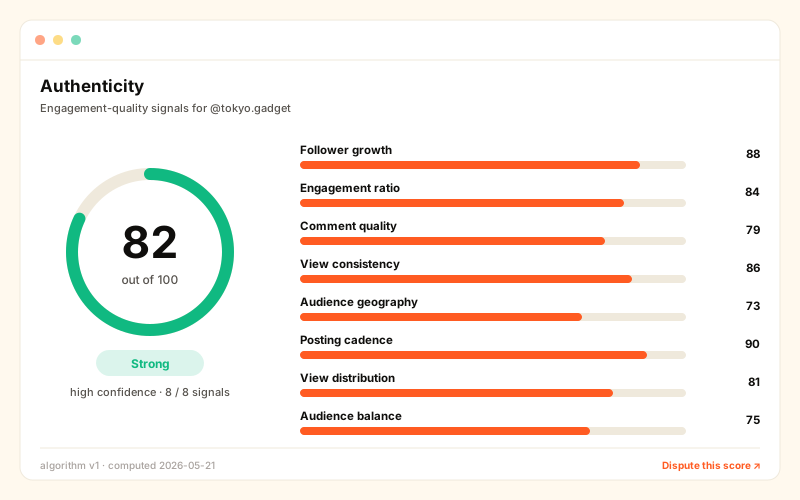
What the score is — and what it is not
When you evaluate a TikTok creator for a paid collaboration, the hard part is not finding the follower count — it is judging whether the engagement behind that count is healthy. Comments, likes, view spread, and growth shape all carry information, but reading them by hand across a shortlist of twenty creators is slow and inconsistent.
The authenticity score compresses that judgment into one number. For any creator with enough scraped history, KOLens computes a composite engagement-authenticity score from 0 to 100 and shows it on the creator dossier. A higher number means the engagement profile looks consistent and healthy. A lower number means one or more signals are irregular enough to deserve a closer manual look.
It is important to be precise about what the score is not. It is not a verdict, and it is not an accusation about any creator. A low score does not tell you why a profile is irregular — only that it is, and that you should spend a little more of your vetting time there before committing budget. Plenty of honest creators score in the middle: a recent viral video, a pivot to a new niche, or a genuinely cross-border audience can all move the number. The score is a starting point for a conversation, not the end of one.
The 8 signals, in plain language
The composite is built from 8 sub-signals. Each one is scored separately, each contributes a weighted sub-score, and the Authenticity card shows a bar for every signal with a short plain-language note. Here is what each signal looks at.
1. Follower-growth pattern
Whether the follower count has grown along a smooth, organic-looking curve or in abrupt steps. Steady accumulation is the healthy baseline. Sudden vertical jumps are not automatically a concern — one viral video can add a hundred thousand followers honestly — but the shape is one input the score weighs.
2. Engagement ratio
The creator's median engagement rate — likes plus comments plus shares, relative to views — measured across recent videos. KOLens uses the median rather than the mean so a single outlier video does not distort the picture. A rate that sits in a healthy band for the creator's size scores well.
Compute this for any TikTok creator
KOLens runs a live search and returns up to 200 creators with engagement rate already computed from real video data — try the free calculator first on a single creator.
Open the calculator →3. Comment quality
The comment-to-like ratio. Healthy audiences comment as well as like. A profile with many likes but very few comments has a thinner kind of engagement, and the comment-quality signal reflects that.
4. View-count consistency
How tightly view counts cluster across recent videos. Most established creators settle into a recognisable range. Wild swings from video to video — far beyond what one viral hit would explain — lower this signal.
5. Audience-geography consistency
Whether the audience reachable through the creator's content comes from a coherent set of regions. A stable geographic footprint scores well; a scattered, incoherent one lowers the signal. Pair this with the audience snapshot to see the actual country breakdown.
6. Posting-cadence regularity
How regular the creator's posting rhythm is. A creator who posts on a recognisable schedule reads as a stable channel. Erratic gaps and bursts lower this signal — and a long recent silence is worth catching before you sign a four-week campaign.
7. Video view distribution
The shape of the spread of views across the creator's library — whether reach is broadly distributed or concentrated in a few videos. This is related to view consistency but looks at the whole distribution rather than video-to-video variance.
8. Audience-demographic balance
Whether the audience profile is balanced in the way an organically grown audience tends to be, rather than skewed in a way the other signals cannot explain. It is the broadest signal and, like the rest, it is one input among several — never read in isolation.
How to read the confidence tiers
A score on its own is incomplete. The same number can rest on solid evidence or thin evidence, so KOLens always pairs the score with a confidence tier. The tier is driven by how many of the 8 signals could be computed:
- High confidence — 6 or more signals available. The score rests on a broad evidence base; treat it as a reliable part of your shortlisting.
- Medium confidence — 4 to 5 signals available. A usable signal, but confirm it against the per-signal bars before it carries much weight in a decision.
- Low confidence — 2 to 3 signals available. Read it as a hint only. Lean on manual vetting and the audience snapshot instead.
- Insufficient data — fewer than 2 signals. KOLens does not show a real score here (see the next section).
The practical rule: a 78 at high confidence is a much stronger basis for action than a 78 at low confidence. The circular badge on the Authenticity card is colour-tiered — green, yellow, red, or grey — and the tier label sits right next to the number so you never read one without the other.
Why "insufficient data" appears — and what to do
Sometimes the Authenticity card shows a greyed-out 50 labelled insufficient data instead of a coloured score. This is intentional. KOLens shows a neutral 50 — never a misleading high or low number — whenever it cannot stand behind a real measurement. It happens when any of these is true:
- Fewer than 2 of the 8 signals could be computed.
- The creator has under 1,000 followers.
- The creator has fewer than 5 posts.
A neutral 50 means exactly one thing: not yet measured. It is not a middling score and it is not a quiet negative. If you see it, you have two good options:
- Scrape more history. Several signals need a run of recent videos to compute. Pulling a fuller video history for the creator often moves the card from grey into a real tier.
- Vet the creator manually. For genuinely small or new creators, treat them as un-scored and rely on a hands-on look at their content, comments, and the audience snapshot. Many strong micro-creators will simply never have enough data for a high-confidence score, and that is fine.
How to dispute a score
No scoring model is perfect, and a creator or a user may genuinely believe a particular score is unfair. KOLens has a dispute mechanism for exactly this case.
On the Authenticity card there is an option to submit a dispute. When you do, KOLens logs the dispute against that score, recorded together with the algorithm version and the timestamp shown on the card. The score is not silently changed by the act of disputing it — that would make the number untrustworthy in the other direction. Instead the dispute is captured so the score can be reviewed and so the history stays auditable. If you are a creator who thinks your engagement quality is being read incorrectly, this is the route to flag it.
How to combine the score with manual vetting
The authenticity score is most useful as the first filter in a vetting workflow, not the only one. A practical sequence:
- Rank your shortlist. Sort candidates by authenticity score to decide where to spend attention first. High scores at high confidence move toward the top; grey and low-tier creators get a manual review.
- Open the per-signal bars. For anyone you are seriously considering, read the 8 signal bars on the Authenticity card. They tell you which signal pulled a score down — an irregular cadence reads very differently from a thin comment ratio.
- Cross-check the audience snapshot. If a geography or demographic signal looks weak, open the audience snapshot to see whether the audience genuinely fits your market.
- Read the comments yourself. Nothing replaces a two-minute scroll through recent comments. The score points you to the creators where that two minutes is worth spending.
Used this way, the score does what a good screening signal should: it concentrates your limited vetting time on the creators who most need it, and it gives you a consistent, repeatable starting point across an entire shortlist. It does not — and is not meant to — replace the human judgment at the end of the process.
Where to find it
The full Authenticity card lives on the creator dossier inside the KOLens workspace: the colour-tiered circular score badge, the 8 signal bars with their plain-language notes, and the algorithm version and timestamp so you always know how fresh the calculation is. A summary authenticity tier also appears on the public creator pages at kolens.ai/k/<username> for a quick read before you open the full dossier.
To start using it, create a free KOLens account, look up a TikTok creator, and open their dossier — the authenticity score and its confidence tier are waiting on the Authenticity card.
Frequently asked
- What is the authenticity score actually measuring?
- It is a composite engagement-quality signal on a 0-100 scale. KOLens computes 8 sub-signals from a creator's public TikTok data — follower-growth pattern, engagement ratio, comment quality, view-count consistency, audience-geography consistency, posting-cadence regularity, view distribution, and audience-demographic balance — and combines whichever could be calculated into a weighted average. A high score means the engagement profile looks consistent and healthy; a low score means something in those signals is worth a closer manual look.
- Does a low score mean the followers are not real?
- No. The score is a confidence-and-quality signal, not an accusation. A low score tells you the engagement profile is irregular enough that you should vet the creator more carefully before spending budget — it does not tell you why. The cause is often benign: a viral spike, a recent niche pivot, or a cross-border audience. Always read the 8 signal bars and the audience snapshot before drawing a conclusion.
- Why does a creator show 'insufficient data' instead of a number?
- KOLens deliberately refuses to show a misleading number. If fewer than 2 of the 8 signals could be computed, or the creator has under 1,000 followers, or fewer than 5 posts, the score is shown as a neutral 50 in a greyed-out state labelled 'insufficient data'. Scrape more of the creator's video history, or treat the creator as un-scored and rely on manual vetting plus the audience snapshot.
- What do the confidence tiers mean?
- The tier reflects how many of the 8 signals KOLens could compute. High confidence means 6 or more signals were available; medium means 4-5; low means 2-3; and 'insufficient data' means fewer than 2. A 78 at high confidence is a far stronger basis for a decision than a 78 at low confidence — always read the score and its tier together.
- How do I dispute a score I think is unfair?
- Open the Authenticity card on the creator dossier and submit a dispute. KOLens logs the dispute against that score along with the algorithm version and timestamp. The number is not silently changed — the dispute is recorded so the score can be reviewed and so the signal stays auditable.
- Should I reject a creator purely on a low score?
- No. The score is a triage tool — it tells you where to spend your limited vetting time, not who to cut. Use it to rank a shortlist, then confirm with the per-signal bars, the audience snapshot, and a manual look at the comments. The score earns its place by saving you time, not by replacing your judgment.
Read next
TikTok audience snapshot — see where a creator's followers actually live (coming soon)
Sampled country / language / activity / niche signals for any TikTok creator. Honest confidence intervals, no fake demographics. Coming to KOLens.
Posting cadence, account age & creator silence — what KOLens measures
Don't sponsor a dead channel. KOLens computes account age, first/last video, median posting cadence and videos-per-week for any TikTok creator — flags accounts that quietly stopped posting.
The brand-fit dossier — Creator Overview, Deep Analysis, and Background Research
Three layered LLM reads on every creator: a free scored Creator Overview gated on the brand profile, a 5-credit Deep Analysis premium tier, and web-grounded Background Research with citations. All cached, all locale-aware.